
Extraordinary Golden Fund
When GRR Goldens require atypical medical expenses, GRR's regular membership and adoption fees are unable to cover the costs (even after generous discounts from area veterinarians). Faced with the prospect of turning away or euthanizing Goldens with high medical costs, we created the Extraordinary Golden Fund. This fund provides a means to target donations specifically for extraordinary medical care. All donations are tax deductable, and there are two ways to donate:
|
DONATE BY MAIL Make a check out to Gold Ribbon Rescue and put EGF in the memo field, then mail your contribution to Gold Ribbon Rescue EGF P.O. Box 956 Austin TX 78767-0956 |
DONATE ONLINE Use the link below to make a donation online using a check, Visa, or MasterCard. Thank you! |
Our latest EGF dogs, Naia, Mikki, and Maverick would like to thank their supporters:
Ann Knight
Ann Nichols
Ann Woody
Anne Williams
Betsy Davis
Bruce Rossiter
Chuck Maier
Connie Sullivan
Dan Flannery
David Deming
Dennis Bobincheck
Dolores Stoner
Elise Stubbe
Gail Gribbin
Gwen Stovall
Harry
Mallard
Helen Almanza
Jeanne Alexander
Kathleen Ragan
Kelly
Topfer
Kim Hawk
Lera Borden
Lisa Savage
Lorraine Thirion
Mark
Stevens
Mindy Garwood
Nancy Martin
Nancy McGowan
Robert Miller
Robin Caldwell
Ruth Ann Lobos
Sheryl Reilly
Susan Wilson
Amazon
Dell
IBM
IGive
Meet some of our Extraordinary Goldens...
December 2010:
He’s been tossed from a moving car, he’s been threatened with shooting, he’s bounced from one home to a second one to a third one and finally to a shelter, he’s cleared heartworm treatment & survived flesh-eating bacteria … what a dog! Now he faces yet one more hurdle: spinal surgery to relieve the back pain he’s living with every day. Can you help this true survivor meet his latest challenge?
Ryder’s story…
In the middle of May, way out in the middle of nowhere, a lone red dog wandered onto a country property. “He must have been dumped,” said the lady who contacted us. “It’s a miracle he found his way to anyone… there is NOTHING out there.” Two toes on one front paw are scarred over and fused together—an injury that our vets speculate resulted from him being pushed out of a moving vehicle and landing with his full weight on just one foot. The finders kept the friendly fellow for just a few days, then bounced him to relatives on the neighboring acreage. But those folks had tiny dogs, didn’t want a big Golden who kept trying to come inside—and a few months later it was, “He’s got to go or we’re gonna take him out and shoot him.” It was time to get Ryder out of there—and fast! The original finders took him back and bounced him over to some friends.
Was he home at last? It looked like it, and the family loved him. “He is so friendly. He jumped right into our car and settled down. In our house, he scrambled onto the bed and curled up and looked so happy. He has been a house dog, I just know it. He knows commands, too.”
… but a vet visit revealed heartworms, and with finances an issue, that family placed him with a couple who’d seen the handsome red fellow at the clinic. But a few days later – “We don’t want to deal with the heartworm treatment. Please take him back.” Now what? Feeling painted into a corner, the family picked Ryder up, dropped him off at the shelter, and called GRR – “please help!”
And at long last, on August 14, the roving dog found open arms and an open door into the safe and loving home he so deserved. Heartworms, hookworms, anemia, skin problems… we had our work cut out. But who wouldn’t want to help such a great guy? “He is sweet and friendly, always ready to go for walk or ride but mostly a calm, patient companion wanting to be wherever his people are. He's beautiful and has such soulful eyes. His goal in life is just to be close to you. He can even talk! If you don't pet him enough, he lets you know, not by barking but by a series of growls and guttural sounds with variations in tone and tempo.”
By mid-November, heartworm treatment was over … but something else was bothering wonderful Ryder. He was slow to get up, slow to jump into the car, and clearly painful when he tried to sit down. He even began to stumble a bit. It was back to the vet for X-rays and a closer look at his back and hips.
“Bridging spondylosis at the lumbosacral junction,” said the vet’s report. In plain English, the area between two of the vertebrae in Ryder’s lower back is unstable, and in response to that, the bones have thickened and the area around his spine has become inflamed, narrowing the spinal canal and putting pressure on the nerve roots. He has pinched nerves in his spine, and that produces pain comparable to sciatica in humans – ouch! He tries to avoid positions and movements that hurt, but the only real way to alleviate his pain is to perform a surgical decompression of the nerve roots by going in and relieving the pressure. Once that’s done, there’s a 90 percent chance he’ll be pain free.
The operation won’t be inexpensive: even after our discount, the cost is about $2,200. But if anyone deserves that happy, pain-free life, it’s Ryder. “I can’t think of any extraordinary mannerisms to use in his story,” said his foster mom (soon to be his forever mom) apologetically. “He is just extremely loveable. He is just a classic, loving, handsome gentleman and his presence is comforting.” For all he’s been through, we think that’s extraordinary enough!
Can you help Ryder? The smallest donation will make a big difference to a wonderful dog. All funds raised will go into our Extra-Ordinary Golden Fund to help Ryder, and other dogs that need help beyond our financial abilities. Thank you so much for your kindness.
Sincerely,
The GRR Board of Directors
August 2008:
Chewy...Last update! Main thing is, I had my first hip surgery (on my left hip) AND spay surgery at the same time. It sure seemed to me like a series of most unfortunate events – who wants to spend so much time at the doc’s? But mom tells me I’m actually really, really fortunate to get all fixed up like this. The hospital staff said I was a real sweetheart and my foster parents were amazed at how well I put up with the E-collar, restricted activity, hours in the crate while I healed… I just took it all in stride. Heck, Mom complains more when she stubs her toe than I did the entire two weeks I was in “suspended animation”! Oh, other really great news, I finally got this housebreaking thing down and haven’t had an accident in a long while. Mom says I did great not to backslide despite all my medical stuff lately.
Anyway, I am a happy girl now, because I finally got to get my sutures out on the 29th of July and got that darn E-collar off my head on the 1st of August. Yay! After that I was allowed to play with my brothers and sister again. It took a couple of days for them to realize that I was well enough, but tonight we had another loud three-way bitey head (somehow, we never have a four-way bitey head). What a blast! I’m on antibiotics now to ensure I don’t get an infection of my hip suture area and I’m doing just great on the drugs. I take pain medication once a day and that really helps, too.
Mom told me that now that I’m over the worst (spay and first hip surgery) that the real training will begin. No more mouthing and no more pulling like a freight train (OK, at 41.5 pounds, perhaps not a freight train…more like a small steam locomotive with a poor maintenance record!). Now, about my size—I’m probably always going to be a small girl, but that’s an obvious plus for those of you who like a smaller-size Golden ( lapdog dimensions!). I also have very distinctive naturally curly nose whiskers. I’m affectionate, I am willing to sleep in when required (hey, my foster parents are retired), I don’t guard food or toys, I don’t bark very often (just the occasional yelp), and I seem to be getting more comfortable every day.
I need to return to the clinic in late August to get a recheck, and after that I’ve still got hip surgery #2 to go, so I’m not going to be available for adoption until the middle of September. BUT, if you want to adopt me before I get through that second operation, by all means talk with my foster mom and she’ll give you the complete skinny on getting me through it! GRR will foot the bill, of course.
Thanks to everyone who has contributed to my care so far. I love being treated like the extraordinary girl I am! Please come to meet me… I know I can make some family really happy!
04/22/08:
Sometimes we get a “highly
adoptable” Golden—young (but not too young), healthy, housebroken, good with
cats, good with kids, known vet history… how much better could it get?! However,
as GRR’s president once said, “Yeah, but if rescue were always that easy, you
probably wouldn’t need rescue groups.”
The
truest rescues are the dogs who are highly UNadoptable at the start—too young &
weak, too old, too sick, or too injured to walk right into an adoptive home.
When a shelter or a Good Samaritan looks at one of those Goldens and says, “Who
could possibly want a dog like THIS one?”… then we say, “We do.”
In the
past two weeks alone, we’ve taken in two such special-needs Goldens. One is just
starting out in life, the other has already lived a lot—but both of them need
new lives. Here are their stories.
Trucker: the
little puppy who could
Hotline message from San Antonio on April 10: “There’s a Golden Retriever puppy under our truck in the driveway. We just found him lying there a couple of days ago. There’s something wrong with his skin & he’s really timid. We have been putting food out for him, but he can’t stay here. Can you help? If you come while we are gone, please take him. No one is looking for him.”
Action stations! A flurry of phone calls, e-mails, and vet arrangements followed, and two GRR volunteers arrived the next day… and found a purebred little Golden in very sad shape. “Three or four months old. Lethargic, unresponsive. I literally had to pull him out from under the truck, although he did take a few biscuits. You can tell he feels lousy. No hair on his ears for the most part, lots of hair loss on face and legs. I just wanted to pull him close and hug him. His little life has been just miserable so far.”
Almost too weak to stand, the pup was carried into the clinic
and installed in a kennel. He still looked awful, but at least he now looked
like somebody cared. And it always helps to have a cheering squad! The clinic
staff promptly conducted a “name that pup” contest, and chose the perfect
moniker: “Trucker,” because this pup really does keep on truckin’. He has
sarcoptic mange (hence the bald spots), a skin infection—and worst of all,
parvovirus. For the first few days, Trucker went downhill. Vomiting, bloody
diarrhea, fever, extreme weakness. The clinic put him on IV fluids—vitally
important in treating parvo, since it kills in part by dehydration. Dogs
with this devastating illness can’t take anything by mouth, to spare damage to
their already compromised GI tracts, so Trucker is getting antibiotics and
anti-nausea drugs in his IV as well. He has daily blood counts, too, because
parvo also attacks the bone marrow. By April 16—five days after he arrived at
the vet’s—the diarrhea had abated, and Trucker was able to stand on his own and
give a tiny tail wag when the staff sweet-talked him. On Thursday the 17th, the
diarrhea stopped, the vomiting slowed way down, and he even went for a little
walk outside and wagged his tail when he saw another dog in the distance! By
Saturday the 19th, he hadn’t vomited for 48 hours and his temperature had been
normal for 36 hours. And by Monday the 21st, he was eating small amounts of
canned food, drinking water—and keeping it all down. And each time he goes out
for a walk, he wants to be a little more active. Everyone says, “He’s a
sweetie!”
Will Trucker make it? We sure hope so, but he’s not out of the woods yet. Parvovirus is very serious, especially in puppies—and more so for pups like Trucker, who have other problems, too. His current bills are running about $69 per day, and there’s no general rule for how long treatment needs to continue. But just take a look at his pictures. And we’re all hoping that some day we can show another “after” photo: a grown-up happy Golden with a plush fur coat and a loving family surrounding him.
Vivi: shining through
The day after baby Trucker arrived at the clinic in San Antonio, an Austin shelter called about a truly ancient Golden found stray near a Petsmart. Likely a dumped dog, and clearly severely neglected. The staff warned us, “You guys realize this gal is probably 15 years old, and she has A LOT of problems. Tumors, teeth worn down to the nub from chewing. Rear end has hard skin from fleas/dermatitis. She was matted so badly urine could not escape, so she has scalding. Quite a trooper and a sweetie though.”
No matter! Almost before she’d hung up the phone, Margo was speeding off to meet the spunky senior. The shelter wasn’t kidding about her health. But… one look, and you could clearly see the beautiful young dog she’d once been shining through the very old Golden she is today. And WHAT a personality! She glowed with serenity and trust, with a lightness of spirit that triumphed over her physical woes: eyes infected, skin infected, heavy matting. Teeth actually caked with fur and dirt (from chewing at herself). Two big black tumors, the size of ping-pong balls, hanging from one lip and one hock. The worst ear infection Margo had ever seen; the ear was swollen, angry, and dripping pus. But incredibly: “She’s cheerful, alert, perky. Having a blast socializing with the staff, friendly and curious with everyone. I AM NUTS ABOUT HER.”
No question where this girl was going… home with Margo, to live out her days as a “permanent foster.” But she needed a name, something as light and vivacious as she is. “Vivian” seemed to fit perfectly—just right for a dog with such joie de vivre.
The next few days were a whirlwind for Vivi. Bathing, grooming, trimming, vaccinations, tooth cleaning, flushing and treating her painful ear. The ugly tumors came off neatly under light sedation. Vivi enjoyed her trips to and from the clinic… riding shotgun, grinning from ear to ear. And just look at her now—what a glamor girl! She’s carefree at last, and will stay that way.
Over the
years we have brought in so many wonderful dogs who needed extra help. Maybe one
of them is even living in your home today. I have two in mine! –
Darla, #06-095, left outside
the San Antonio shelter with a huge, festering abscess on her neck (the fish
hook that caused the injury was still lodged in the flesh); and
Bebe, #07-031, picked up stray
with a horribly mangled front leg and slipping into shock. Without the help of
GRR, both dogs would have been euthanized at the pound. That didn’t happen, and
every day I look at my beautiful, lively girls and feel so grateful to have
them.
Can you
help give a special Golden a second chance? We can’t save all of them, but we
can always, always try. Please donate to our Extraordinary
Golden Fund. You can make a general contribution or ask that your dollars go
to caring for one dog in particular. Any amount will help. Thank you from all of
us at GRR!
Princess
January 2008:
Once upon a time, a beautiful princess lost her kingdom and everything she
owned. For some time, she wandered the highways and byways, living the life of a
vagabond and depending on the kindness of strangers for a sip of water, a bite
of food, and shelter from the sun and rain. One day, she met a kind family who
offered her a place to stay. “We don’t have much room,” they said, “but you are
welcome to live with us.” And admiring their new lodger’s noble spirit and
gracious heart (in which, indeed, they were not deceived), they named her
Princess.
Now, when she lived in her own kingdom, Princess occasionally traveled the
countryside incognito, visiting her subjects and making sure that all was well…
something that all good rulers like to do. At the peak of the winter holidays,
she decided to take a tour of her new territory, and in a surprisingly un-royal
lapse of judgment, did not say a word to her family, but slipped away silently.
For four long days they waited and wondered, not knowing if they would ever see
their Princess again. And then…
A little figure appeared in the distance, bobbing down the road and up the
drive. It was Princess! But what had happened? She was hopping on three legs,
while the fourth dangled uselessly in the air. Had she had an encounter with a
fire-breathing dragon, been set upon by footpads, been injured in a duel? She
didn’t say… and her smile was as happy as ever. Still, her family could tell she
needed an expert physician, and truth to tell, things were a bit crowded with
one big Princess and many other little ones!
Fortunately, they soon figured out what to do, and placed a call to Gentry
Rescue and Rehabilitation, Inc., a local organization dedicated to helping
canine aristocrats in need. Within a day, an impressive coach drew up at the
door, and out stepped a GRR representative. Princess had not forgotten her royal
upbringing and briskly hobbled forward with a smile, a bob, a curtsey, a bow,
and a furious tail wag-plus-derriere-wiggle combination (now wherever did she
learn that? NOT in finishing school!). She was clearly the Genuine Article, and
in a twinkling she was handed into her carriage. A heartfelt thanks and farewell
to her family, and she was on her way to her next adventure…
They say that life is not a fairy tale, but we’re hoping that you can help this
Princess get the happy ending she deserves! As the story tells you, she was
picked up stray a few months ago by a wonderful family who already had lots of
little dogs, but nonetheless made room for one more; but when she showed up
badly lame after a four-day absence, they contacted GRR for help. Our volunteer
Kathy was of course charmed by Princess, and commented that she didn’t think the
injury could be too bad, since Princess was all smiles, wags, and good cheer. So
you can imagine our shock when an X-ray revealed that her shin bone was not only
broken, but shattered and smashed into so many pieces that there was no way to
reassemble it. (She probably did have a run-in with a fire-breathing dragon, in
the form of a car.) She’d need surgery and a plate in her leg, and the sooner
the better. Everyone who knows Goldens knows how stoic they can be, maintaining
that happy spirit even when they’re ill or in great pain… and Princess is an
outstanding example of that!
The surgery went perfectly, and Princess is now in rehab. Her foster mom says,
“This is such a NICE dog. Everything a Golden Retriever should be. She is a
solid girl who takes everything that comes her way. Wonderful personality and
attitude. Somebody spent some time with her. She is housetrained, loves
everyone, does great with other dogs, comes up to you and sits right down in
front you for a treat or a pat. It’s adorable. She doesn’t particularly care for
her Elizabethan collar (even though plenty of princesses and queens have worn
one on purpose). She wants to scratch, and it won’t let her, and then of course
she only has one functional hind leg, which makes scratching even harder. So
when we go outside, she lies on her back and just wiggles furiously to scratch
her back and shoulders. It’s hilarious. Her pet name is even Wiggles! She’s
super social and as soon as her leg is healed, she’ll be thrilled to go for
walks and mingle with everyone she meets. She’s the greatest.”
So far Princess has had lots of fairy godmothers and godfathers. The family who
took her in, then GRR, and now, of course, you! She needs many more friends to
help cover the cost of her operation, which ran around $1,500, and of course
some very special new friends to give her a castle and a kingdom once again. Can
you help Princess live happily ever after? If so, just click here.
Thank you from all of us at GRR!
Donnie
February 2007:
For Valentine's Day, I would like:
a. one dozen breathtakingly lifelike roses sculpted from freeze-dried liver (I
promise to admire them before eating them);
b. a heart-shaped meat & cheese appetizer tray (jumbo size, of course);
c. arthroscopic surgery to make my shoulder as good as new;
d. all of the above!
Four-year-old Donnie would probably pick (d), but we KNOW he is going to get
(c)-on February 13th, he's scheduled for repairs to the shoulder that has
probably been paining him for a good long while. And this energetic sweetheart
couldn't ask for a better Valentine's treat than that!
Charming, clever, and handsome, Donnie was found running stray in San Antonio
last September and taken to the Humane Society. From there, he went to a local
family who kept him in the backyard-a lonely life for a social butterfly, so
Donnie became a digger and perfected the art of escapeŠ and eventually, in
December, wound up in the city pound. GRR volunteer Tracy went to meet him and
was won over! "He's very intelligent and eager to please. Every time I spoke to
him, he was VERY interested in what I had to say, as if he really understood me.
I would guess he'll be a total cuddler." Donnie's family, tired of his roaming
ways, elected not to bail him out-and so, on December 21, he came to GRR.
First happy surprise-Tracy reported she was pretty sure the affectionate fellow
was housebroken, as, despite obvious tummy turmoil, he managed to hang on until
she screeched to a halt at the vet's and he could use the outdoor "facilities."
Next, we got the wonderful news that he was heartworm negative. After a
much-needed bath and trim, Donnie moved into his foster home. As he settled in,
more hidden talents came to light. For example, he proved to be a Stealth Sofa
Warmer (somewhat to his family's chagrin!). Then, the considerate dog displayed
a real aptitude for Quality Control Management, thoughtfully testing his mom's
gourmet cooking for flavor, texture, and appetite appeal. Strolling into the
living room with frosting and strawberries adorning his nose, he was able to
assure her that the fancy cake on the kitchen counter was perfectly acceptable
for guests. (Funny, mom didn't seem to appreciate his opinion as much as she
should have.) Mud Wrestling was the next skill to come to light-on a trip to the
dog park, "Donnie went to a large mud puddle, tasted the water, and then lay
down in the mud. We think he likes water."
From the start, though, his mom and dad noticed that his right front leg wasn't
quite right. Especially after exercise, he'd stiffen up and limp. This boy is
peppy and likes to play hard! - but sometimes he just couldn't manage it. After
a few weeks, they were worried enough to take him to the vet. The doctor was
concerned, too - the shoulder was painful, clearly inflamed, and "felt" funny:
he even worried that Donnie might have bone cancer. X-rays clearly ruled out any
tumors (whew)-but "I've never seen anything quite like this. It's like there are
pieces of bone floating around in the joint. Donnie needs to see a specialist."
That's just what Donnie did, and the problem turns out to be a "joint mouse" -
not the furry little rodent, but a piece of joint capsule that broke off
(probably early in Donnie's life) and has now mineralized. As it moves around
within the joint, it causes inflammation, discomfort, and damage. The vet says
that Donnie's condition is like having a pebble sliding around in your shoe:
sometimes it's uncomfortable, other times downright painful, depending on just
where the "mouse" is. The very good news here is that arthroscopic surgery can
solve the problem. The prognosis is excellent: once he recuperates for a couple
of weeks, Donnie should be almost as good as new, and able to play as much as he
wants!
Donnie's surgery won't be cheap, though - it carries a price tag of about
$1,000, in addition to the $250 already spent on diagnostics. Can you help make
Donnie's Valentine's Day the best ever? Any amount, no matter how small, will
help this wonderful Golden and others like him have a healthy, happy, active,
pain-free future. Thank you so much for your help!
Rali
August 2006
 Rali... Gentle Rali (pronounced to
rhyme with “Holly”) came to GRR this spring, when his loving owner
could no longer care for him. She had found him wandering down a rural
road a few years earlier, and though she posted signs and ran ads,
nobody ever came looking. Hard to believe! – because Rali turned out
to be one great dog. “He is smart, laid-back, a wonderful
companion. He listens really well. He’s a gentleman—if you gave him a
newspaper and a cigar I can just see him putting on his glasses and
settling down in an armchair to read the financial news and have a
smoke!"
Rali... Gentle Rali (pronounced to
rhyme with “Holly”) came to GRR this spring, when his loving owner
could no longer care for him. She had found him wandering down a rural
road a few years earlier, and though she posted signs and ran ads,
nobody ever came looking. Hard to believe! – because Rali turned out
to be one great dog. “He is smart, laid-back, a wonderful
companion. He listens really well. He’s a gentleman—if you gave him a
newspaper and a cigar I can just see him putting on his glasses and
settling down in an armchair to read the financial news and have a
smoke!"
Unfortunately, as 2006 began, Rali’s owner found herself facing some serious health troubles—just as Rali himself began to have real issues with skin allergies. Realizing she could not give her much-loved Golden the medical attention and care he needed, she contacted GRR.
We got going with medicated shampoos two or three times a week, an oral anti-fungal to battle infection, and of course high-quality food and skin supplements. Several months on, we are happy to say that this boy is so much better, and achieving the good looks to match his A-plus personality!
Rali’s foster dad noticed fairly soon that Rali had a hard time getting up and down from the floor, climbing up steps, and so on. He’d plop down instead of gradually lowering himself, and sometimes he was just reluctant to move at all. At first, we wondered if it was just typical older-dog arthritis, but it quickly became clear that something more serious was going on. It was back to the vet for X-rays and a closer look at his back and hips.
The diagnosis was lumbo-sacral disease. The area between two of the vertebrae in Rali’s lower back is unstable, and in response to that, the bones have thickened and the area around his spine has become inflamed—narrowing the spinal canal and putting pressure on the nerve roots. He has pinched nerves in his spine, and that produces pain comparable to sciatica in humans – ouch! He tries to avoid positions and movements that hurt, but the only real way to alleviate his pain is to perform a surgical decompression of the nerve roots by going in and relieving the pressure.
Rali had his surgery on August 16 and came through with flying colors. He returned home to start his recuperation on August 18. His foster dad says, "Rali is in good spirits and would like to be up and around, but he has activity restrictions for a month. He'll go back to the clinic in 2 weeks to have his staples out, and then at 4 weeks for a reevaluation by his doctors. He is very happy to be home and would like to extend his personal thanks to everyone who has helped him through this difficult time. He looks forward to taking walks around the neighborhood and romping in the backyard not too long from now!"
Total costs: $1,831.
Ranger
February 2006
 Looking at this handsome one-year-old, you’d never suspect that, just
a month ago, we weren’t sure if he’d even make it. Brought to the
shelter as a stray, young Ranger had only been in his foster home for
a week when a worried message came in from his foster mom: “I’m
getting a little concerned about Ranger. He’s been throwing up
since he woke up this morning. He’ll lie down, but when he gets up it
seems to aggravate him and he'll throw up. I can't imagine what
might cause him to feel this way, since he has mostly been inside with
us yesterday and today. He isn’t eating or drinking, either.”
Looking at this handsome one-year-old, you’d never suspect that, just
a month ago, we weren’t sure if he’d even make it. Brought to the
shelter as a stray, young Ranger had only been in his foster home for
a week when a worried message came in from his foster mom: “I’m
getting a little concerned about Ranger. He’s been throwing up
since he woke up this morning. He’ll lie down, but when he gets up it
seems to aggravate him and he'll throw up. I can't imagine what
might cause him to feel this way, since he has mostly been inside with
us yesterday and today. He isn’t eating or drinking, either.”
“Take him to the doctor right away,” said GRR’s Medical Coordinator, Mike Chamberlain … which was a good call, because what sounded like stomach upset turned out to be very severe pneumonia—something we are seeing more & more often this year in shelter dogs, unfortunately. The vet was so worried that she wouldn’t even send Ranger home, and an hour later, foster mom Louisa was on her way to the emergency clinic, where Ranger spent the night on IV antibiotics. The next several days were touch and go, with Louisa shuttling Ranger to the clinic each night for treatments, then picking him up at 6:30 each morning and delivering him to Griffith Small Animal Hospital for more treatments during the day … not to mention the home nebulizer treatments and antibiotic administration over the weekend in between.
After a week of intensive hospital and home care, Ranger began to turn the corner. Another 2 weeks, and “Ranger is doing great,” says Louisa. “He jumped up on the bed this morning and sat on my chest, with his tail wagging in my face. He’s funny!”
Overnight emergency care, X-rays, daytime therapy and boarding, antibiotics, and inhalation therapy for Ranger: $1,614
Milly
December 2005
 In early November we got a call from a Good Samaritan in
Waco. A rescue group there had taken in an older blonde Golden found
wandering stray, but they didn’t really have room for her. They put
her at about seven years old, noted that she was good with kids, and
sent a Halloween photo of a sweet-looking white-faced girl nattily
attired in a kerchief and posing with a pumpkin.
In early November we got a call from a Good Samaritan in
Waco. A rescue group there had taken in an older blonde Golden found
wandering stray, but they didn’t really have room for her. They put
her at about seven years old, noted that she was good with kids, and
sent a Halloween photo of a sweet-looking white-faced girl nattily
attired in a kerchief and posing with a pumpkin.
A week or so later, “Milly” arrived in Austin. Temperament – super! Exactly as advertised. Wonderful with kids, wonderful with adults, wonderful with other dogs. Age – more like ten than seven. But healthwise, the poor girl was a mess. It was obvious she had been living rough for a long time.
The good news – she’s heartworm negative and already spayed! On the “needs help” list: she’s at least twenty pounds overweight, and her coat is harsh and scanty – both due to an underactive thyroid. She had a terrible bladder infection and was in so much discomfort from it that she trembled from head to foot and could hardly stand still. She has a big cyst on her back, ugly but harmless – we can easily remove it. There are lots of lipomas (fatty tumors) on her chest. More troubling, though, are the huge mammary tumors on her belly, which we hadn’t been able to see in her photos: one grapefruit-sized, the others egg-sized. We won’t know if they’re cancerous or not until they’re removed, but early indications are that they may just be enormous lipomas.
The plan of action – Milly needs to lose some weight and get
healthier before her surgery. Once she’s on the mend, we’ll take off
the tumors and the cyst, give her very dirty teeth a much-needed clean
– and she’ll look and feel like a new girl and be ready for her
forever home.
Costs for check-ups, shots, bloodwork, antibiotic therapy, and surgery: approximately $1,000.00
Honey Boy "Future's So Bright"
January 2005
In Summer 2004, a Good Samaritan found a weak, skinny Golden near a Houston highway, straying into traffic. She collected him on the spot and headed right to her vet for a check-up. “Honey Boy” (as he was soon named for his sweetness of spirit) proved to be severely diabetic, emaciated, virtually blind due to extensive cataracts on both eyes—and only about 5 years old. GRR was contacted, and we set to work. First order of business was getting the diabetes under control, and what a long haul that proved to be! Recurrent infections and bouts of diarrhea plagued Honey Boy, but with the help of our vets and a great foster family unfazed by the daily insulin injections their Golden boy required, the loving dog finally stabilized, put on some much-needed weight, and became strong enough for a long-postponed neuter surgery. Next up was a trip to the eye doctor. “The cataracts are operable!” was the verdict.
On Friday, January 21, 2005, Honey Boy’s cataracts were broken up and removed. Reports his foster dad, “On Saturday morning, he was still a little swollen, but in good spirits. Sunday was better, and Monday has been great. We played a little fetch (indoors). He can’t be to active yet, but he can see! Everything seems to be healing well… he is still getting used to seeing the world again.”
Eye exam and cataract surgery: $1,334.
Chewie "No More Earaches, Ever"
January 2005
 Chewie’s
original owners discarded him in the overnight drop box at Town Lake
Animal Center. He was itchy and loaded with fleas. With his saggy
tummy and sparse coat, Chewie wouldn’t have made much of an
impression, if it wasn’t for his big, bright-eyed, happy grin.
Chewie’s
original owners discarded him in the overnight drop box at Town Lake
Animal Center. He was itchy and loaded with fleas. With his saggy
tummy and sparse coat, Chewie wouldn’t have made much of an
impression, if it wasn’t for his big, bright-eyed, happy grin.
In foster care, Chewie snuck below our radar…integrating seamlessly into our gang of six Goldens…slipping behind us onto the couch…curling up in the Lazy Boy recliner in my office… melting into the crowd for the 5:00 dog drive. It was as if he had lived with us before—he was so familiar and comfortable and easy to be with.
There was just one cloud in Chewie’s happy new life. Chronic, neglected ear infections had literally squeezed his ear canals shut and made it impossible to heal the infection beneath: no air or medication could even get through. The stoic old fellow was in constant pain—waking us up at night as he moaned softly and rubbed his ears against the floor, shaking his head hard enough to cause hematomas (blood-filled swellings) on his outer ears. After checking his progress over his first few weeks in care, Chewie’s doctor got to the point. “Chewie needs surgery on those ears! The canals have improved a bit, but not enough. There is pus in there. There is probably pus and infection all the way down to his middle and inner ear. There is calcification of the external ear canal because of life-long infections that weren’t treated. I can’t even get an ear scope in to take a good look. The only thing to do is an ear ablation: removing the entire ear canal (taking it out and sewing it up). With all that infection and inflammation gone, he’ll be pain-free at last. He has suffered enough!”
On January 13, Chewie headed to the hospital for the operation. It was a success! After a few days of observation at the clinic (during which time the entire staff and all the vets fell in love with him, of course), he returned to his foster home and his favorite perch on the Lazy Boy. He’s recovering nicely now and not a bit bothered by his bad haircut!
Cost of a pain-free future for Chewie: $1,735.
Alleh lay alone in the boarding kennel, seizing uncontrollably, his last two doses of Phenobarbital forgotten. His owner traveled for business and could not care for the tall blond boy. She quietly told GRR, "His Vet says you may have to put him to sleep." We grimly began blood tests. Alleh’s life depended on controlling the frequent Grand Mal seizures. Timers set. Medicine administered precisely on time. Neighbors dispensed pills if the foster family was gone. Dosages adjusted. More blood work. Two months and the Phenobarbital reached therapeutic range. Now two-year-old Alleh is seizure free and magnificent. He and his adoptive parents foster other Goldens in need.
Cost: Innumerable hours of dedication, $300 of tests.
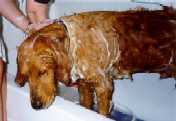 Walker’s fur feels like an SOS pad, and
he has almost no coat. He has a huge hot spot where his pantaloons
should be and his body is covered with fleabite dermatitis." At
age two, Walker was surrendered by a well-meaning young couple with a
baby, no money, and way too many animals. Tall and congenial, Walker
spent his weeks in foster care itching. Skin flaked away layer by
layer. We treated Walker for tapeworms, battled fleas, did a skin
scraping, bought hypoallergenic shampoo, fed him derm caps, and hid
Cephalexin tablets in peanut butter. Walker’s skin cost us as much as
an entire second dog.
Walker’s fur feels like an SOS pad, and
he has almost no coat. He has a huge hot spot where his pantaloons
should be and his body is covered with fleabite dermatitis." At
age two, Walker was surrendered by a well-meaning young couple with a
baby, no money, and way too many animals. Tall and congenial, Walker
spent his weeks in foster care itching. Skin flaked away layer by
layer. We treated Walker for tapeworms, battled fleas, did a skin
scraping, bought hypoallergenic shampoo, fed him derm caps, and hid
Cephalexin tablets in peanut butter. Walker’s skin cost us as much as
an entire second dog.
My sister’s neighbor left a couple of months ago and never returned for Savannah. She’s tied to a tree. We have her papers." Maura recognized the kennel name…an old dog and his son were rescued years earlier…same story…abandoned, tied to a tree. Long nails, filthy coat, filthier ears, intact, fleas, every rib obvious, Savannah was one month away from her 5th birthday. Still trusting of humans, the dark red girl was also heartworm positive. We x-rayed her chest to check for heart enlargement, and okayed pricey pre-op blood work, afraid that she was too far gone for spay surgery and heartworm treatment. "Thumbs Up," grinned her vet, "Let’s proceed." Spectacular care, full recovery, we would need the equivalent of four adoption fees to cover Savannah’s expenses.
 Rocky’s owners followed the same
protocol as Savannah’s…Own a dark red dog, don’t neuter him, don’t
give him medical care, and abandon him when you move. "It's
getting awfully cold and he has no shelter. The moving van left 10
days ago. There is a bag of food but no water. Please save him,"
plead the neighbors. Three days before Christmas, 9:00 p.m. rescue,
emergency transport, foster home flip-flops. The topper: our masculine
boy was diagnosed heartworm positive. Well, Rocky must have hung his
stocking on the fireplace mantel. An anonymous donor to the EGF
covered his treatment.
Rocky’s owners followed the same
protocol as Savannah’s…Own a dark red dog, don’t neuter him, don’t
give him medical care, and abandon him when you move. "It's
getting awfully cold and he has no shelter. The moving van left 10
days ago. There is a bag of food but no water. Please save him,"
plead the neighbors. Three days before Christmas, 9:00 p.m. rescue,
emergency transport, foster home flip-flops. The topper: our masculine
boy was diagnosed heartworm positive. Well, Rocky must have hung his
stocking on the fireplace mantel. An anonymous donor to the EGF
covered his treatment.
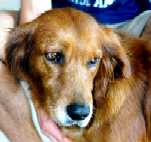 The college girls whispered as they told
us Lily’s story. "We’re hiding her in the dorm. The janitor helps
us, but we’re afraid we’ll be caught. We gave her a bath and rigged up
a leash. We put up posters and advertised for her owner, but we’ve
given up. Will you take Lily before we’re kicked out?" Calm and
sedate, polite Lily accompanied us down frat row on a Saturday night,
while her young rescuers headed to the bars for some fun. The next
morning, we examined Lily in the daylight. White on her chin,
grape-sized cyst on her back, the old gal looked to be in pretty good
shape. Grandly, we declared "Let’s take that lump off. She’ll be
look more like a college girl without it."
The college girls whispered as they told
us Lily’s story. "We’re hiding her in the dorm. The janitor helps
us, but we’re afraid we’ll be caught. We gave her a bath and rigged up
a leash. We put up posters and advertised for her owner, but we’ve
given up. Will you take Lily before we’re kicked out?" Calm and
sedate, polite Lily accompanied us down frat row on a Saturday night,
while her young rescuers headed to the bars for some fun. The next
morning, we examined Lily in the daylight. White on her chin,
grape-sized cyst on her back, the old gal looked to be in pretty good
shape. Grandly, we declared "Let’s take that lump off. She’ll be
look more like a college girl without it."
We put Dad in the nursing home. Pick up his dog," the man instructed Williamson County Humane Society. Morley weighed 92 lbs., had feet the size of dinner plates, and was calm and gentle. The staff called him their "big love sponge". He won their hearts, and then tested positive for heartworm. Meanwhile GRR’s funds were at an all-time low, foster homes filled beyond capacity. We reluctantly turned Morley away, "We just can’t afford another heartworm positive dog who also needs routine vetwork." …Morley’s fate changed positively because three wonderful things: WCHS offered astronomical discounts on vetwork, a foster home stepped forward, and donations were made to the Extraordinary Golden Fund.
Boy, Angus, Irish, Colleen, Katie, Patty, Connie, and Tess

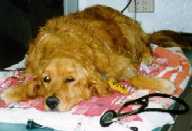 We lifted 5
Goldens from plastic crates and pulled 3 more from behind a pickup
seat. They were skeletal refugees from a Texas border town animal
shelter. Each filthy body was covered with hundreds of ticks. What
coats they had were badly matted. Production line veterinary care
began…check for dehydration, shock, and anemia, pull ticks, test for
heartworm.
We lifted 5
Goldens from plastic crates and pulled 3 more from behind a pickup
seat. They were skeletal refugees from a Texas border town animal
shelter. Each filthy body was covered with hundreds of ticks. What
coats they had were badly matted. Production line veterinary care
began…check for dehydration, shock, and anemia, pull ticks, test for
heartworm.
"Boy" couldn’t stand straight. He dragged his rear as he walked and seemed to have no control over urination or defecation. Grateful for our hugs, he leaned his fragile frame against ours. X-rays revealed a broken spine, likely originating from his pickup as a stray, 3 months earlier. There was nothing we could do for him. We held Boy in our arms and gently put him to sleep. There was no adoption fee to help cover the cost.
We were able to save Angus & Irish, Colleen, Katie, Patty & Connie. Tess didn’t make it. We took turns talking to her as she lay on the exam table, hoping for good news. Dehydrated, depressed, in shock, something was seriously wrong. Multiple blood tests, antibiotics, IV’s, blood transfusions; after days of tender care, Tess died. Final diagnosis: tick anemia. Financial diagnosis: many expenses, no adoption fee.
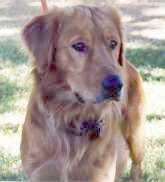 Raja is two and wise beyond his
years. Contemplative Raja understands what we say and makes us
speculate about telepathy. Just when you think he is the reincarnation
of a Hindu prince, Raja whips ‘round the corner with a tennis ball in
his mouth, a troop of golden playmates in tow. "Dog of a
Lifetime?" we whisper, as we matchmake for him, "Who
deserves our Raja?"
Raja is two and wise beyond his
years. Contemplative Raja understands what we say and makes us
speculate about telepathy. Just when you think he is the reincarnation
of a Hindu prince, Raja whips ‘round the corner with a tennis ball in
his mouth, a troop of golden playmates in tow. "Dog of a
Lifetime?" we whisper, as we matchmake for him, "Who
deserves our Raja?"
His doctor solemnly broke the news. "We hear a heart murmur, and it’s loud." X-rays reveal problems. How long would he live? What prognosis could we give? "Dog of a Lifetime?" we thought, and found Raja a specialist. $200 echocardiogram added to his earlier bill, we push away thoughts of the expense.
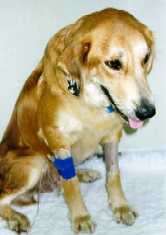 "Come get her, they’re killing
dogs tomorrow," the shelter worker pleads. "She had seven
pups but all of them died." Monique’s young son named her
"Toxie," and the next morning she collapsed.
"Come get her, they’re killing
dogs tomorrow," the shelter worker pleads. "She had seven
pups but all of them died." Monique’s young son named her
"Toxie," and the next morning she collapsed.
Emergency spay, fever of unknown origin, white blood count at 70,000. Blood tests for Brucellosis, Valley Fever, Complete Blood Profile; 11 days at the vet. Again and again, the discussion…was she viable, recoverable, adoptable? We were ready to give up. Toxie’s doctors countered, donating her ultrasound, her boarding, her IV antibiotics while we waited for results. Was it an abscess? Toxoplasmosis? A fungal infection? At each stage we consulted with doctors and with each other. What was the cost of each test, each antibiotic, each last chance…would $40 save her life? At the $1,000 mark, the two year old made the decision to live.
Toxie moved home to Monique’s. Perhaps the bribe of Chicken a la King for every meal was what did it. The little mama gained weight and found her spirit. Now Toxie lives with two engineers and a Pekinese. Her new name is Casey, and she was an $850 loss for Rescue.
 Winchester was left for dead, shot in
the leg. College students drove him to Austin but had no money for
treatment. X-rays showed bone fractures. Difficult surgery; five pins
bolted in the leg, crate rest for months while the fractures
healed. Complete success. These days, Winchester works at the office,
gets biscuits from the UPS man, and carries his leash to whomever he
selects as his walking escort.
Winchester was left for dead, shot in
the leg. College students drove him to Austin but had no money for
treatment. X-rays showed bone fractures. Difficult surgery; five pins
bolted in the leg, crate rest for months while the fractures
healed. Complete success. These days, Winchester works at the office,
gets biscuits from the UPS man, and carries his leash to whomever he
selects as his walking escort.
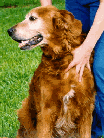 Bailey’s teeth were atrocious.
They needed cleaned and scaled. We wondered if the worst should
be pulled to prevent a systemic infection. At age 10 – 12, his
ability to handle anesthesia was questionable. Preliminary blood
work would tell us if he could handle the risk. We did run the
extra tests, Bailey’s teeth were cleaned, and now when the old boy
smiles, he gleams. Bailey had a thyroid problem which
necessitated more tests and yet another dentistry which will hopefully
be his last.
Bailey’s teeth were atrocious.
They needed cleaned and scaled. We wondered if the worst should
be pulled to prevent a systemic infection. At age 10 – 12, his
ability to handle anesthesia was questionable. Preliminary blood
work would tell us if he could handle the risk. We did run the
extra tests, Bailey’s teeth were cleaned, and now when the old boy
smiles, he gleams. Bailey had a thyroid problem which
necessitated more tests and yet another dentistry which will hopefully
be his last.